
Ebook Free How We'll Live on Mars, by Stephen Petranek
How We'll Live On Mars, By Stephen Petranek. The developed modern technology, nowadays sustain every little thing the human requirements. It includes the everyday activities, tasks, workplace, amusement, and a lot more. Among them is the terrific web link and computer system. This condition will alleviate you to sustain among your hobbies, checking out practice. So, do you have ready to review this publication How We'll Live On Mars, By Stephen Petranek now?
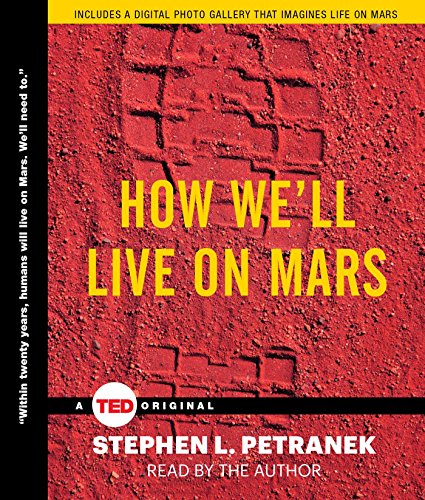
How We'll Live on Mars, by Stephen Petranek

Ebook Free How We'll Live on Mars, by Stephen Petranek
How We'll Live On Mars, By Stephen Petranek In fact, publication is really a window to the globe. Even many people could not such as checking out publications; the books will constantly provide the specific info regarding truth, fiction, experience, experience, politic, religious beliefs, as well as more. We are right here a site that provides compilations of publications greater than the book shop. Why? We give you great deals of numbers of link to obtain guide How We'll Live On Mars, By Stephen Petranek On is as you require this How We'll Live On Mars, By Stephen Petranek You could discover this publication quickly here.
Undoubtedly, to enhance your life quality, every e-book How We'll Live On Mars, By Stephen Petranek will have their specific session. However, having certain awareness will make you feel much more certain. When you feel something occur to your life, often, reviewing book How We'll Live On Mars, By Stephen Petranek could help you to make calm. Is that your actual hobby? Occasionally of course, yet often will certainly be unsure. Your option to review How We'll Live On Mars, By Stephen Petranek as one of your reading books, could be your appropriate publication to read now.
This is not about how much this publication How We'll Live On Mars, By Stephen Petranek expenses; it is not likewise concerning just what kind of book you truly love to review. It is about what you could take and also obtain from reviewing this How We'll Live On Mars, By Stephen Petranek You could like to select other e-book; but, no matter if you try to make this publication How We'll Live On Mars, By Stephen Petranek as your reading option. You will not regret it. This soft documents publication How We'll Live On Mars, By Stephen Petranek can be your excellent friend regardless.
By downloading this soft file e-book How We'll Live On Mars, By Stephen Petranek in the on the internet web link download, you remain in the first action right to do. This site actually provides you simplicity of exactly how to obtain the ideal e-book, from best seller to the brand-new launched publication. You can find more publications in this website by visiting every web link that we offer. Among the collections, How We'll Live On Mars, By Stephen Petranek is among the most effective collections to offer. So, the initial you get it, the initial you will certainly get all positive about this book How We'll Live On Mars, By Stephen Petranek
Award-winning journalist Stephen Petranek says humans will live on Mars by 2027. Now he makes the case that living on Mars is not just plausible, but inevitable.
It sounds like science fiction, but Stephen Petranek considers it fact: Within twenty years, humans will live on Mars. We’ll need to. In this sweeping, provocative book that mixes business, science, and human reporting, Petranek makes the case that living on Mars is an essential back-up plan for humanity and explains in fascinating detail just how it will happen.
The race is on. Private companies, driven by iconoclastic entrepreneurs, such as Elon Musk, Jeff Bezos, Paul Allen, and Sir Richard Branson; Dutch reality show and space mission Mars One; NASA; and the Chinese government are among the many groups competing to plant the first stake on Mars and open the door for human habitation. Why go to Mars? Life on Mars has potential life-saving possibilities for everyone on earth. Depleting water supplies, overwhelming climate change, and a host of other disasters—from terrorist attacks to meteor strikes—all loom large. We must become a space-faring species to survive. We have the technology not only to get humans to Mars, but to convert Mars into another habitable planet. It will likely take 300 years to “terraform” Mars, as the jargon goes, but we can turn it into a veritable second Garden of Eden. And we can live there, in specially designed habitations, within the next twenty years.
In this exciting chronicle, Petranek introduces the circus of lively characters all engaged in a dramatic effort to be the first to settle the Red Planet. How We’ll Live on Mars brings firsthand reporting, interviews with key participants, and extensive research to bear on the question of how we can expect to see life on Mars within the next twenty years.
- Sales Rank: #2133963 in Books
- Published on: 2015-07-07
- Released on: 2015-07-07
- Formats: Audiobook, CD, Unabridged
- Original language: English
- Number of items: 2
- Dimensions: 5.75" h x .60" w x 5.00" l,
- Running time: 7200 seconds
- Binding: Audio CD
About the Author
Stephen Petranek’s career of more than forty years in the publishing world is marked by numerous prizes and awards for excellent writing on science, nature, technology, politics, economics, and more. He has been editor-in-chief of the world’s largest science magazine, Discover, the editor of The Washington Post’s magazine, founding editor and editor-in-chief of This Old House magazine for Time Inc., senior editor for science at Life Magazine, and group editor-in-chief of Weider History Group’s ten history magazines. His TED talk, 10 Ways the World Could End, has been viewed over a million times. He is now the editor of Breakthrough Technology Alert, for which he finds the investment opportunities that create true value and move the human race forward.
Stephen Petranek’s career of more than forty years in the publishing world is marked by numerous prizes and awards for excellent writing on science, nature, technology, politics, economics, and more. He has been editor-in-chief of the world’s largest science magazine, Discover, the editor of The Washington Post’s magazine, founding editor and editor-in-chief of This Old House magazine for Time Inc., senior editor for science at Life Magazine, and group editor-in-chief of Weider History Group’s ten history magazines. His TED talk, 10 Ways the World Could End, has been viewed over a million times. He is now the editor of Breakthrough Technology Alert, for which he finds the investment opportunities that create true value and move the human race forward.
Most helpful customer reviews
72 of 74 people found the following review helpful.
Speculation, information, and an occasional misstep.
By Harry E. Keller
This book has plenty of good information and speculation with only a few errors. This is a topic that is extremely difficult to write about without making any mistakes at all. It's quite possible to write accurately one day and have that accuracy destroyed by new developments and discovery before actual publication. It's hard to explain to those who have not tried, the incredible breadth of knowledge required to discuss travel to and living on Mars unless that person has attempted it. As one who has essayed this effort in both fact and fiction (see ETCJournal.com and Mars Rhapsody), I can tell you it's a tough job. This book does the topic reasonable justice.
This book is designed to be read in a single sitting. As a result, it often does not plumb the depths of some topics. Quite a bit of the book details the history of the ideas of travelling to Mars, beginning with Wermer von Braun (pronounced: Verner fawn Brown).
Petranek covers the psychological, economic, and physical issues involved in getting to and living on Mars rather completely. He spends some time on Mars One and Elon Musk, suggesting that the former is a very long shot due to funding issues (I agree) and that the latter is almost guaranteed to succeed for a variety of reasons (I agree again). He spends a bit too much space on slamming NASA, albeit with some good reasons. He even indicts Richard Nixon as the primary person responsible for us not reaching Mars already.
As to the errors, they are relatively minor compared to the scope and thrust of the book. For example, the author writes, "When you run out of oxygen in a space suit, you can only breathe the carbon dioxide that you exhale for so long before you lose consciousness." In fact, you will die of carbon dioxide "poisoning" long before you use up the oxygen. Assuming that you are breathing regular air, oxygen is 20% of the content, and carbon dioxide is much less than 1%. By the time CO2 reaches 5%, O2 has dropped to just 15% because one CO2 molecule is produced for each O2 used. You have used up just 1/4 of the O2 available and are dead.
Petranek is very correct about no animals on Mars. They are much too inefficient as a source of food. He remarks that early Martian settlers will be vegetrarians. They'll actually be vegans, meaning that special attention must be paid to vitamins D and B12. These are available from sources such as yeast, lichen, and mushrooms. He also says that settlers are unlikely to produce more than ten percent of their own food. This pessimistic view contrasts strongly with some of his other optimism. Advances in genetic engineering, aeroponics, and fast hybridization should alter this forecast considerably. Self-suffciency is not just nice, it's a necessity.
The remarks on radiation are fairly accurate. Everyone should understand that radiation in space is about twice as harmful as that on Mars because cosmic rays come from all directions and are shielded from half of the cosmic sphere by Mars itself. Solar radiation also is shield half of the time, nighttime, by the planet as well.
Another pervasive issue is oxygen and atmospheric pressures. We have to have an oxygen partial pressure of around 150 millibars or so to survive. This is the pressure at the highest cities on Earth and is less than 1/6 of the pressure of the Earth's atmosphere at sea level. Even if the entire atmospheric pressure were this low, your blood would not boil. Other physiological processes may not be so amenable to low pressures. However, we should find out how low the pressure can go if we keep the partial pressure of oxygen constant at 160 millibars. Lower pressures mean lower construction costs and also have strong implications for terraforming Mars. In my book, Mars Rhapsody, I took the most optimistic view that you could live at 160 millibars of total pressure with all of it coming from oxygen.
The suggestion that plants can convert the CO2 into O2 in adequate amounts is way off. Mars has maybe 8-10 millibars of CO2. Converting it all to O2 would produce only that amount of oxygen, which is 20 or so times to low. Bacteria, lichen, and plants cannot "fix" Mars alone. We must have a much greater souce of O2. However, genetic engineering humans may be possible to make tolerating high CO2 levels and surviving with low O2 levels possible, but not without lots more O2 than you can get from plants.
The potential for genetic engineering humans to make them more radiation resistant, able to eat and metabolize plants that grow on Mars, making them able, perhaps by making them smaller, able to subsist on a limited diet, and allowing them to breathe much thinner air is explored in the book. The question not addressed is when these altered humans become a different species. What if we populate Mars to save our species but do so in such a way as to create an entirely different species? Earth humans, as we know them, may not be able to emigrate to Mars after all.
More discussion would be nit-picking. There's plenty in this book to recommend it. No one, even me, gets this entirely right, and no one knows all of the answers or even all of the problems. For a quick overview of how we'll get to Mars and how we'll live there, this is a very decent essay.
8 of 8 people found the following review helpful.
All an average person is looking for on the topic
By Jay Batson
The author itemizes the various challenges associated with humans inhabiting mars, and the best thinking (to date) on how we'll be able to tackle them. There is some attention paid to the relative difficulty, and readiness to achieve each one.
My personal conclusion is that some of the proposed solutions are unlikely to happen as described. Example: terraforming in order to release oxygen stored in surface ice to create an atmosphere presumes we can control the outcome precisely enough. But we (humans) can't seem to control the greenhouse gas emissions enough to minimize impact on the planet we have; how are we going to be any better at hitting a target on Mars?
But, this was an interesting read nonetheless.
4 of 4 people found the following review helpful.
Errors and Exaggerations; Better Reviews Available
By ComMarBen
This little book is a fast, easy read, for which I give the author the first star. And grudgingly one more star for bringing further attention to a number of intriguing future possibilities regarding our neighboring planet. However, in doing so, he falls prey to various overly enthusiastic “visionaries” who have little appreciation for the challenges of what they claim may come to pass.
A much more reasoned, balanced and comprehensive narrative is available in the more recent book, “Mars: Our Future on the Red Planet,” which was commissioned by National Geographic to accompany their TV series on MARS. As expected, the large format artwork and photographs of Mars are spectacular.
But in his book, Petranek claims right away in his intro “the settlement of Mars is about to happen far sooner than most people realize.” Wrong, I’m afraid. The question, rather, is will some of still be alive by the time NASA and the world actually pony up to sending just a very modest crew of marsonauts to the surface of the red planet.
The author takes his optimistic viewpoints from interviews with only those self-proclaimed visionaries who have never participated in any actual missions to Mars and tend to be naïve about the challenges. In the book, many issues are misrepresented. As if it isn’t enough for Elon Musk’s fanciful claims he will build a rocket that will loft one hundred people all the way to Mars (the Saturn V could only send 3 ‘nauts to the moon, with only a couple week’s worth of food, water, TP, etc.), Petranek claims he was told by Musk that he will send 80,000 settlers in a single trip (p. 33).
Similarly, the author swallows the Zubrin claim that terraforming is a sure bet, and simple to accomplish. Something far less challenging would be ex post facto “fixing” global warming on Earth. Petranek seems uninformed that space-borne mirrors cannot simply remain stationary over a pole of Mars --- that works only at the equator. And, if it were feasible at Mars, wouldn’t entrepreneurs on Earth have conspired to convert Siberian permafrost into tropical farmland long ago?
You don’t have to be a rocket scientist to see that many of these visionary proposals are far into the future, if feasible at all. The author is neither a scientist nor a rocket expert, but doesn’t mind opining, incorrectly, that there have been no advances in rocketry since the Saturn.
The author seems to have researched only recent Mars exploration, attributing many of the discoveries originally made at Mars by the 1976 Viking missions instead to the rovers exploring the landscape decades later. Several statements are blatantly ignorant of fundamental scientific facts, such as the claim that hydration of nitrates releases nitrogen, when it is the nitrate that is the fertilizer for plants and the nitrogen in the atmosphere is useless except in special cases involving bacteria. Or, that the problem with Mars is distance, when it actually is time (once we blast off a rocket from Earth to go to Mars, it is coasting virtually the entire distance, but you cannot speed up the transfer without sacrificing the amount of mass that you can transfer).
There are better books available to get a glimpse of what Mars could provide in our future. If this is the only one you read, and believe, you will be regrettably misinformed.
How We'll Live on Mars, by Stephen Petranek PDF
How We'll Live on Mars, by Stephen Petranek EPub
How We'll Live on Mars, by Stephen Petranek Doc
How We'll Live on Mars, by Stephen Petranek iBooks
How We'll Live on Mars, by Stephen Petranek rtf
How We'll Live on Mars, by Stephen Petranek Mobipocket
How We'll Live on Mars, by Stephen Petranek Kindle
0 komentar:
Posting Komentar